
Blood Sugar and Perimenopause: The Connection Nobody Explained to You
It was 3pm on a Tuesday, and I was standing in my kitchen staring into the fridge like it owed me money.
I wasn’t even hungry. I’d had lunch. A good lunch. And yet there I was, absolutely convinced I needed something sweet, something salty, something anything, right now, immediately, no further questions.
I grabbed a biscuit (fine, three biscuits), sat back down, felt vaguely awful about it, and then felt tired again twenty minutes later. Same as every day.
I’m a health coach. I know about food. I’ve been coaching women for years. And I could not figure out why I was behaving like a sleep-deprived toddler every afternoon.
Isn’t it mad how you can know so much and still have your own body completely blindside you? That’s perimenopause for you. 😂
Here’s what I eventually worked out: it wasn’t about willpower. It wasn’t about being weak or undisciplined or eating too much. It was about blood sugar and specifically, what perimenopause was doing to mine.
If you’ve been dealing with cravings, energy crashes, unexplained weight gain around your middle, or waking up at 3am wired and tired at the same time — this post is for you. Let’s actually explain what’s happening.
First, a quick primer on blood sugar (I promise to keep this interesting)
Blood sugar is literally just the amount of glucose in your bloodstream at any given time. When you eat carbohydrates, your body breaks them down into glucose, which goes into your blood. Your pancreas then releases insulin, a hormone whose job it is to escort that glucose into your cells to be used for energy.
When this system works well, it’s elegant. You eat, you get energy, you feel good, you carry on.
When it goes wrong — when your blood sugar spikes too high and then crashes, or when your cells stop responding to insulin properly — you get the full collection: cravings, fatigue, weight gain, brain fog, anxiety, and sleep problems.
And in perimenopause, this system is under significant pressure.
What perimenopause is actually doing to your blood sugar
Do you know what the missing piece is in most perimenopause conversations? Oestrogen.
Specifically, what oestrogen does for your blood sugar and what happens when it starts to fluctuate.
Oestrogen isn’t just a reproductive hormone. It plays a significant role in how your cells respond to insulin. When oestrogen is stable (hello, your 20s and 30s), your cells are relatively sensitive to insulin — meaning it takes a reasonable amount to do its job.
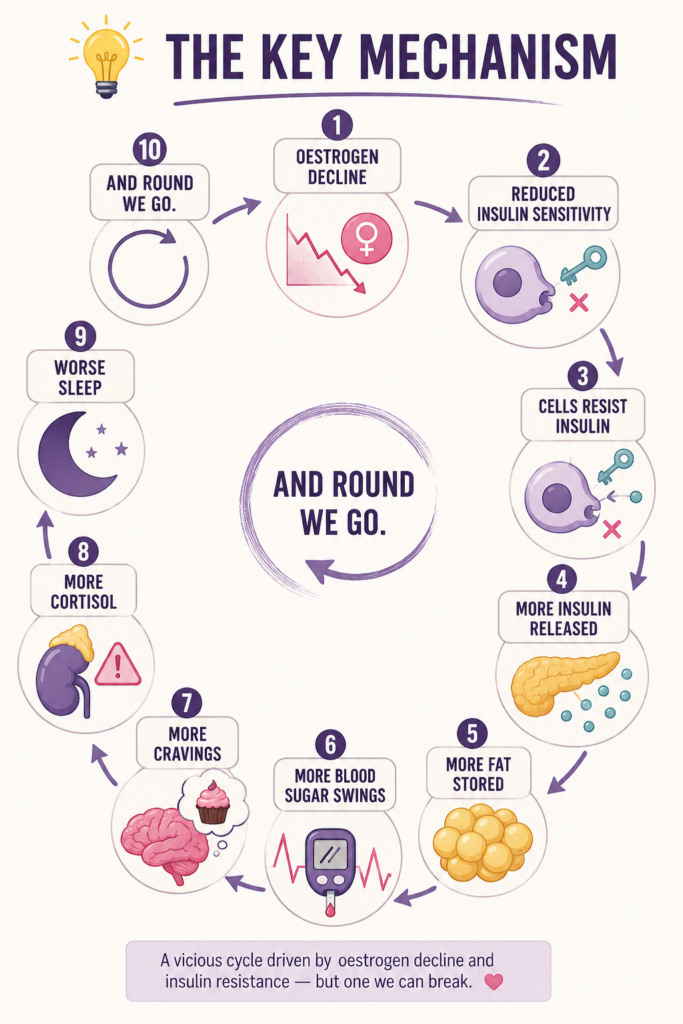
As oestrogen begins to fluctuate and decline in perimenopause, your insulin sensitivity drops. Your cells start to become insulin resistant meaning they don’t respond to insulin as well as they used to. Your pancreas has to pump out more insulin to get the same result. And more insulin in your bloodstream means more fat storage, more cravings, more energy crashes.
To be honest, this was the thing nobody had connected for me. I thought insulin resistance was something that happened to other people, or people who ate very badly. Not me. Not a health coach who eats vegetables and walks every day.
But here I was.
Perimenopause changes your metabolic baseline. Full stop.
The 5 signs your blood sugar is all over the place
Some of these will be very familiar.
- The 3pm crash. You could put your head on your desk. Every. Single. Day.
- Cravings that feel urgent. Not a gentle “oh, a biscuit would be nice” — more of a “I need sugar RIGHT NOW and I cannot explain why.”
- Feeling hungry again shortly after eating. Especially if your meal was carb-heavy or low in protein.
- Waking up between 2–4am. Not because you need the loo — because your blood sugar has dropped and cortisol has surged to compensate. Your body is literally stress-waking you.
- Belly fat that won’t budge. High insulin = fat storage. Specifically around the middle. This is one of the reasons your body shape may feel like it’s changing even when your diet hasn’t.
If you’re nodding at three or more of those, your blood sugar is part of your story.
Want the exact blood sugar fix I use myself?
Download The Blood Sugar Fix — my free guide that walks you through the specific foods, meal timing strategies, and blood sugar habits that actually work in perimenopause. No calorie counting. No restriction
Why the standard advice doesn’t work for us anymore
You’ve probably been told: eat less, move more. Cut the sugar. Maybe try intermittent fasting.
And you’ve probably tried it. And it probably didn’t work the way it used to.
Here’s why.
In perimenopause, skipping meals or eating very little can spike your cortisol. Cortisol tells your liver to dump glucose into your bloodstream as an emergency energy source. Blood sugar goes up even though you didn’t eat anything. Insulin gets released. Fat storage increases. You feel awful and wonder what you’re doing wrong.
Aggressive restriction doesn’t fix insulin resistance in perimenopause. It often makes the metabolic chaos worse, and it makes you miserable in the process.
Your body is not broken. It’s protecting you. But it needs a different strategy now.
What actually works: How to stabilise your blood sugar in perimenopause
This is the practical bit. And it is genuinely not that complicated. It just requires understanding why you’re doing it.
1. Prioritise protein at every meal
Protein slows down how quickly carbohydrates are absorbed into your bloodstream, which means gentler blood sugar rises and no crash afterwards. It also keeps you full for longer which is exactly why the standard low-calorie meals leave you ravenous by 2pm.
Aim for 25–30g of protein at breakfast, lunch, and dinner. This isn’t bro-science gym talk — it’s the number that actually moves the needle for blood sugar stability and reducing cravings. Think eggs, Greek yoghurt, salmon, chicken, cottage cheese, lentils.
(If you want a head start: my free 7 High Protein Breakfasts guide has a week of options that take under 10 minutes.)
2. Eat carbs… but eat them last
This sounds strange but there’s real research behind it. If you eat your protein and vegetables first, and then have your carbohydrates, your blood sugar spike is significantly reduced compared to eating the carbs first.
You don’t have to give up carbs. Honestly, I’m not here to tell you to never eat pasta again. But food order matters more than you think and it’s one of the simplest changes you can make without overhauling your entire diet.
3. Never eat carbs alone
Toast with butter. Fine. Toast with nothing. Blood sugar rollercoaster.
Pair every carbohydrate with a protein or fat. Apple and almond butter. Rice and chicken. Crackers and hummus. The fat or protein slows the glucose absorption and prevents the spike-crash cycle.
4. Go for a walk after meals
Your muscles use glucose for energy when you move. A 10–15 minute walk after eating can reduce your blood sugar spike by up to 30%. It doesn’t have to be fast. It doesn’t have to be a workout. Just moving.
This is actually one of the three pillars of The Midlife Method. Post-meal walking is one of the most underrated metabolic tools in perimenopause. I’ve been doing it myself and the difference in my afternoon energy is noticeable.
5. Manage your cortisol alongside your food
Cortisol and blood sugar are deeply connected. Stress spikes cortisol. Cortisol spikes blood sugar. High blood sugar spikes cortisol. It’s a loop and in perimenopause, when your nervous system is already less regulated, this loop can run wild.
Nervous system regulation isn’t fluffy. It’s metabolic medicine in perimenopause. Even ten minutes of breathwork, a short walk in daylight, or a genuine rest after lunch can lower your cortisol and support your blood sugar without touching your food at all.
A word about supplements
I’m not going to go heavy on this because supplements shouldn’t be your first move — but for context, some that have evidence behind them for blood sugar support in midlife include magnesium glycinate, inositol (specifically for perimenopause-related insulin resistance), and berberine. Always check with your GP before starting anything, especially if you’re on any medication.
Food first. Always food first. But it’s worth knowing these exist if you’ve got the foundations in place and want to explore further. Here are some of the ones I love.
The thing I wish someone had told me
When I was eating three biscuits every afternoon and feeling ashamed about it, I didn’t need more willpower. I needed to understand what was happening in my body.
Cravings in perimenopause are not a character flaw. The 3pm crash is not laziness. Belly fat that appeared out of nowhere is not because you stopped trying.
It’s hormones. It’s blood sugar. And it’s your body adapting to a new chapter and giving you some pretty clear signals that it needs a different approach.
The good news? Once you understand it, it’s very workable. The cravings actually do get quieter. The energy does stabilise. The weight does start to respond, just not to the same strategies that worked in your 30s.
And to be honest, working with my body instead of against it has felt like the biggest relief of my perimenopause experience. I just wish I’d found it sooner.
xx
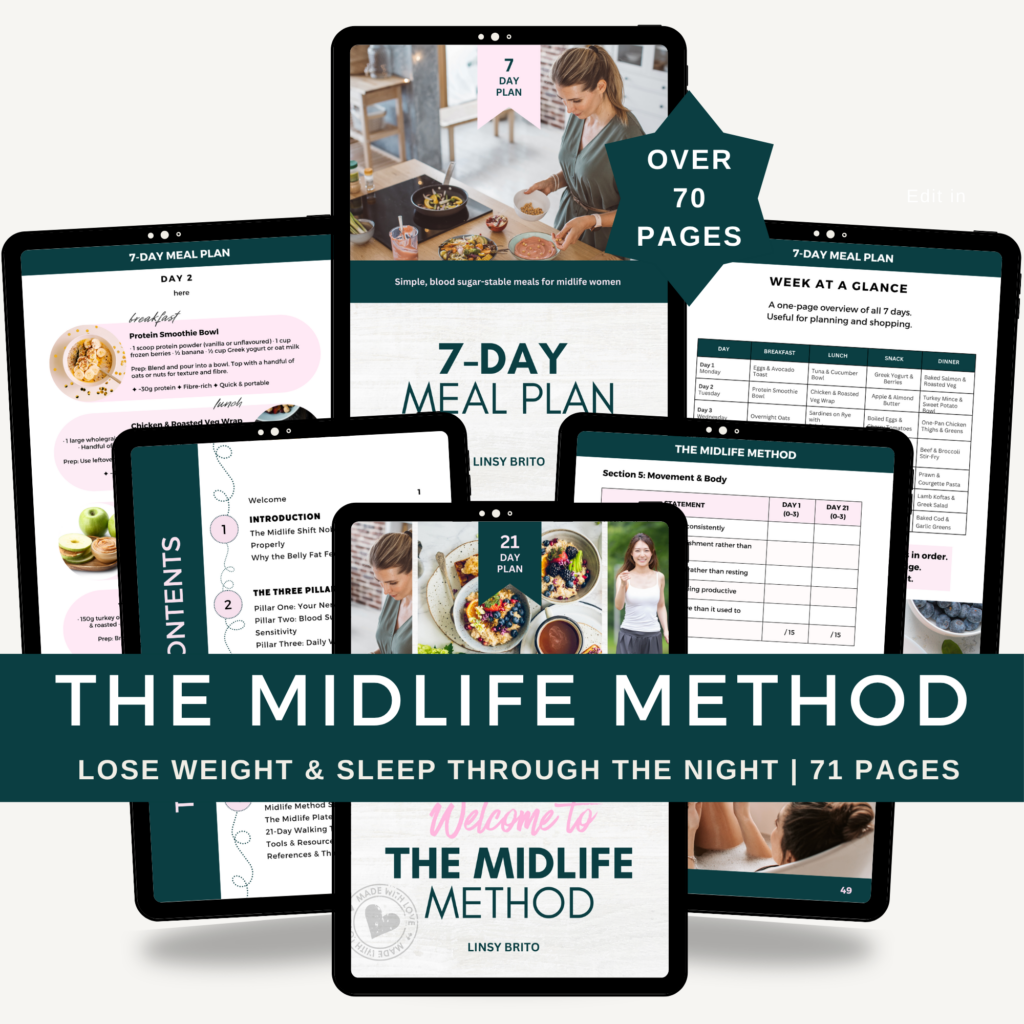
READY TO GO DEEPER? Join The Midlife Method.
My 21-day programme that combines nervous system regulation, blood sugar balance, and daily walking — everything in this post, done with you, step by step. Women are finishing it with more energy, fewer cravings, better sleep, and clothes that fit differently. Not because they starved themselves. Because they finally worked with their body instead of against it