

Waking Up at 3am? Here’s What Your Body Is Actually Telling You
3:07am. Eyes open. Wide awake. No idea why.
You lie there doing that thing where you try really hard not to look at the clock, then look at the clock, then do the maths on how many hours you’ve got left if you fall back to sleep right now. But, you don’t fall back to sleep right now. You lie there listening to everyone else in the house breathing peacefully (your partner, the kids, probably the dog) while your brain decides this is an excellent time to remember every awkward thing you’ve said since 2003.
This was me. For months. And the really fun part? I’m a certified health coach. I knew about cortisol. I’d literally talked to clients about this. And I still lay there at 3am like a complete zombie, wondering why my own body wasn’t listening to me.
Here’s the thing nobody tells you clearly enough: this is not insomnia. It is not anxiety. It is not just getting older.
It’s your cortisol. And once you understand what’s actually happening, you can do something about it.
Why 3am Specifically?
This is the question I get asked all the time. Why always around 3am? And why not 1am, or 5am? Why that specific window where everything feels about ten times worse than it does in daylight?
In a healthy cortisol rhythm, your cortisol sits at its lowest point in the early hours, roughly between midnight and 3am. This is when your body is in its deepest repair and recovery mode. Deep sleep, cell renewal, all of that good stuff.
But in perimenopause, a few things knock this rhythm completely sideways.
Falling progesterone (which has a natural calming, sedative effect) means your nervous system loses one of its key overnight buffers. Fluctuating oestrogen affects how your body regulates blood sugar during sleep. And if your blood sugar drops in the night, which it does more easily when oestrogen is low, your body releases cortisol to bring it back up.
| Here’s the bit that gets me every time. Your body wakes you up at 3am not to be cruel. It wakes you up because it’s trying to keep you safe. Cortisol is sounding the alarm. It thinks there’s a threat. The problem is, there isn’t one. Your body is caught in a hormonal pattern it can’t regulate the way it used to. It’s doing its job. Just at 3am when you really, really need to be asleep. |
Isn’t it mad how something so disruptive is actually your body trying to protect you? I find that both fascinating and deeply annoying in equal measure 😂
What Chronic Night Waking Does to Your Body
The occasional broken night is survivable. We’ve all been there since the newborn days, we know we can get through a bad night on caffeine and stubbornness. But when 3am waking becomes a pattern (weeks, months, sometimes years) the knock-on effects go way beyond feeling tired.
- Cortisol stays elevated. Every single night wake is a cortisol spike. Night after night, that means chronically raised cortisol, and chronically raised cortisol tells your body to store fat, slow your metabolism, and hold on. Especially around your belly.
- Blood sugar becomes harder to manage during the day. Poor sleep directly worsens insulin sensitivity. So the blood sugar rollercoaster you’re already navigating gets even bumpier.
- Hunger hormones go haywire. Sleep deprivation raises ghrelin (the hunger hormone) and lowers leptin (the fullness one). That’s why you’re ravenous the morning after a rough night, and why willpower feels completely useless by 4pm. It is not weakness. It is biology.
- Your nervous system never fully recovers. Sleep is when your nervous system resets. Without it, you start every day already depleted, more reactive, more emotional, less able to cope with the normal chaos of life. The mental load of running a household on no sleep is a completely different beast. Anyone who has been through the newborn stage, or currently has a teenager, knows exactly what I mean.
When I started joining these dots (the 3am waking, the belly that wouldn’t shift, the cravings, the bone-deep exhaustion, the inflammation in my body) I stopped seeing them as separate problems I needed to fix separately. They were all pointing at the same thing. A cortisol rhythm that was completely out of sync.
For me personally, the sarcoidosis I live with made this even more obvious. Inflammation and cortisol are deeply linked. High cortisol drives inflammation, and inflammation drives cortisol right back up. Broken sleep sits in the middle of that loop and makes everything worse. Once I understood that, fixing my sleep stopped feeling like a nice-to-have and started feeling urgent.
What’s Making It Worse (That You Probably Don’t Realise)
There are a handful of things almost guaranteed to worsen that 3am cortisol spike, and most of them happen in the evening. Which is why timing matters so much.
Alcohol
I know. I’m really sorry. That glass of wine to decompress after a long day (after the kids are finally in bed, the kitchen is clean, and you’ve had approximately four minutes to yourself) feels completely earned. And in the first half of the night, it does help you drop off. But as your body metabolises it in the second half of the night, it causes a cortisol rebound. Which lands right around 2 to 4am. I tested this on myself, a week with wine versus a week without, and the difference in my sleep was honestly embarrassing given how long I’d been ignoring it. That’s me 😂
Eating late
A big meal close to bedtime, especially one that’s heavy on carbohydrates, causes a blood sugar spike that your body then has to manage overnight. As blood sugar drops in the early hours, cortisol spikes to compensate. If you’re eating late because life is chaotic (and it absolutely is, I get it completely) even just shifting the carbs earlier in the meal and adding more protein can make a real difference.
Screens before bed
Blue light suppresses melatonin, which means cortisol doesn’t get the signal to drop for the night. Your body stays in a mild alert state, and when cortisol doesn’t come down properly in the evening, it can’t follow a healthy rhythm overnight. We all know this and we all still do it. The phone goes in another room now for me. Revolutionary. Annoying. Worth it.
High-intensity exercise in the evening
Exercise raises cortisol, that’s literally how it fuels movement. Done in the morning, brilliant. Done at 8pm when you’ve finally got a window, it can keep cortisol elevated right when it needs to be dropping. A walk is probably better than a HIIT class at 9pm if your sleep is broken.
Stress you haven’t processed
Your nervous system does not clock off when you get into bed. If you’ve spent the day in low-level stress mode (notifications, decisions, the constant mental load of running a household and a life and probably other people’s lives too) your cortisol carries that into the night. Your body never got the signal that the day was over and it was safe to rest. This one hit me hard when I first understood it. I’d been expecting my body to switch off just because I’d put my head on a pillow. It doesn’t work like that.
What Actually Helps?
Do you know what’s interesting? You don’t fix 3am waking by doing something at 3am. You fix it by what you do between 6pm and 10pm.
The evening is when you have the most influence over your overnight cortisol rhythm. These are the things that made the biggest difference for me, and they’re all simple enough to actually do on a normal weeknight with a family and a full plate.
Your Evening Cortisol Reset
| Start Here Tonight 1. Eat dinner earlier and balance your plate. Aim for at least 2 to 3 hours before bed. Protein and fat alongside the carbs keeps blood sugar stable overnight. This one change alone made a noticeable difference within a few days for me. 2. Cut off screens an hour before sleep. Or at the very least, switch to warm lighting and put your phone across the room. Even 20 minutes makes a difference. Your phone will survive the night without you. Probably. 3. Do something that signals safety to your nervous system. Five minutes of slow breathing. A warm shower. Reading an actual book. Gentle stretching. Anything that tells your body the threat is over and the day is done. This sounds almost too simple. It works. 4. Keep your room cool and dark. Temperature and light are two of the strongest signals your body uses to regulate melatonin and cortisol. A cool, dark room is not a luxury, it is genuinely functional. And in perimenopause with night sweats in the mix, cool is your best friend. 5. Skip the evening alcohol, even just for a week. Not forever. Just a week. See what happens to your sleep. The results might genuinely surprise you. They surprised me, and I work in this space for a living. |
Evening Cortisol Reset Works
When I started taking my evenings seriously, not just as wind-down time but as an actual biological reset, the 3am waking reduced within about a week. Not gone overnight. But noticeably, meaningfully better. And when the sleep improved, everything else started shifting too. The cravings got quieter. The weight started responding. The inflammation settled.
It all connects. Fix the sleep, and you’re not just fixing the sleep.
| 😴 Want to stop waking at 3am? Why you’re waking at 3am and how to stop it Poor sleep in midlife is almost never just a sleep problem. It’s a cortisol problem. A blood sugar problem. Fix the root cause and sleep fixes itself. |
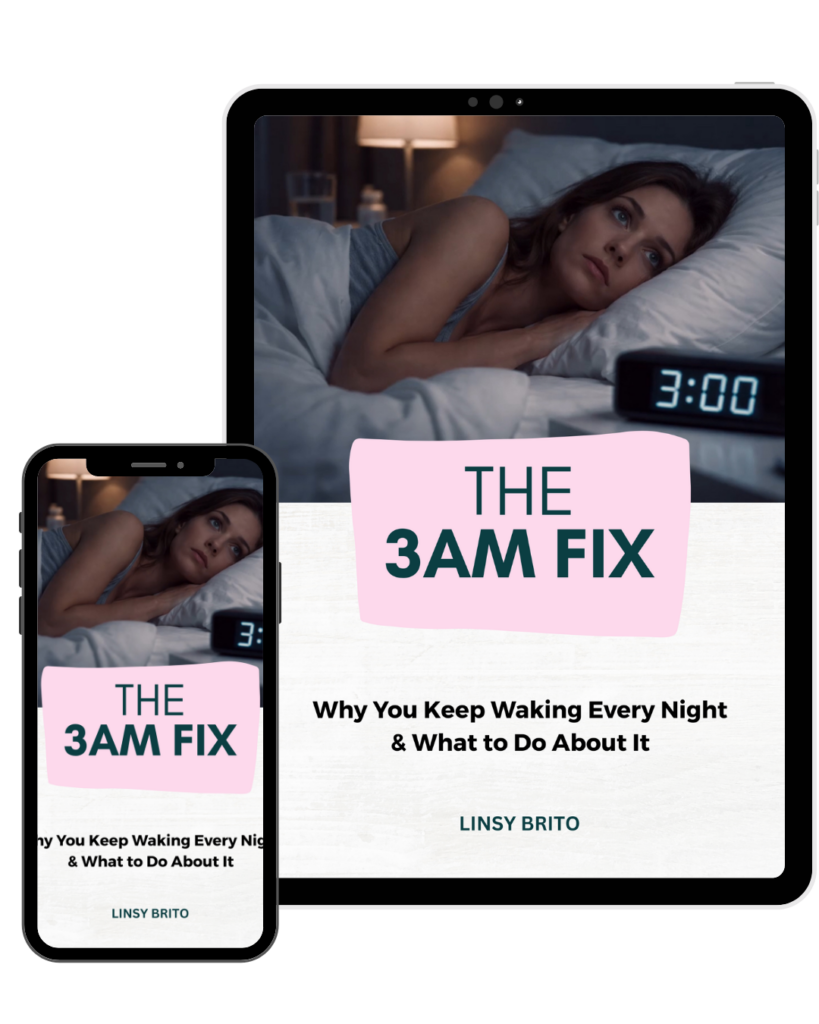
| 🌿 Ready to go deeper? The Midlife Method The 3am Fix is a great starting point. But if you want the full 21-day midlife reset (the one that addresses broken sleep, belly fat, cravings, and exhaustion all at once) The Midlife Method walks you through it step by step. |
The Bottom Line
Waking up at 3am in perimenopause is not random. It is not insomnia. It is not something you just have to accept because you’re in your forties now and apparently this is just life.
It’s a cortisol rhythm problem, and cortisol rhythm problems are fixable. Not with a sleeping pill, not by pushing through, but by understanding what your body is actually doing and giving it what it needs.
You’re not broken. You’re not failing. Your body is doing exactly what it was designed to do, just with completely outdated information.
Give it better information. Start tonight. And come and tell me how you get on.